Light for the forest
English
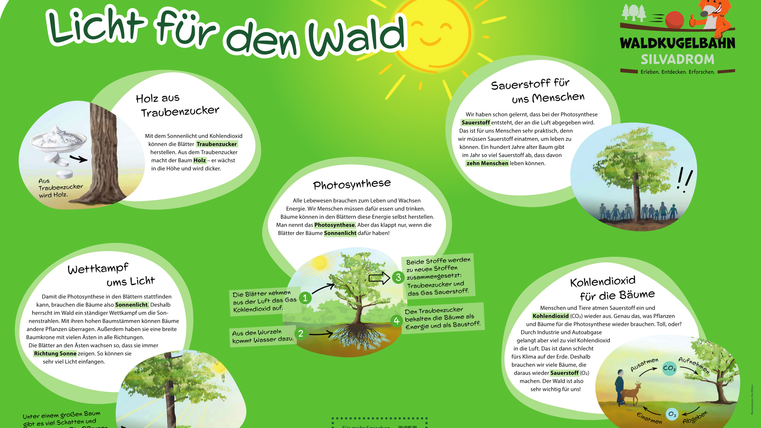
Wood from glucose
With sunlight and carbon dioxide, leaves can produce glucose. The tree uses glucose to make wood – it grows taller and thicker.
Photosynthesis
All living things need energy to live and grow. We humans need to eat and drink for this. Trees can produce this energy themselves in their leaves. This is called photosynthesis. But this only works if the leaves of the trees have sunlight for it!
- The leaves absorb carbon dioxide from the air.
- Water is added from the roots.
- Both substances are combined to form new substances: glucose and oxygen gas.
- The trees retain the glucose as energy and as a building material.
Oxygen for us humans
We have already learned that photosynthesis produces oxygen, which is released into the air. This is very useful for us humans, because we need to breathe oxygen to live. A hundred-year-old tree releases enough oxygen in a year to sustain ten people.
Competition for light
Trees need sunlight for photosynthesis to take place in their leaves. That is why there is constant competition for sunlight in the forest. With their tall trunks, trees can tower above other plants. They also have broad crowns with many branches extending in all directions. The leaves on the branches grow so that they always face the sun. This allows them to capture a lot of light.
Under a large tree, there is a lot of shade and very little light. The plants there grow more slowly and do not grow very tall.
Carbon dioxide for the trees
Humans and animals breathe in oxygen and breathe out carbon dioxide (CO²). This is exactly what plants and trees need for photosynthesis. Amazing, isn't it? However, industry and car exhaust fumes release far too much carbon dioxide into the air. This is bad for the Earth's climate. That's why we need lots of trees to convert it back into oxygen (O²). So forests are
very important for us!
Exhale -> CO² -> Absorb -> Release -> O² -> Inhale -> Exhale …
Light for the leaf
Light for the leaves
English
Deciduous trees can align their leaves with the sun. This allows them to make optimal use of sunlight for photosynthesis.
Feel like a tree on the leaf loungers and turn towards the sunlight.
Leaves in the light
Leaves in the light
English
The leaves of trees are fascinating parts of plants. With the help of sunlight and water from the roots, these little powerhouses produce food for the plant. This is called photosynthesis.
Puzzle together your picture!