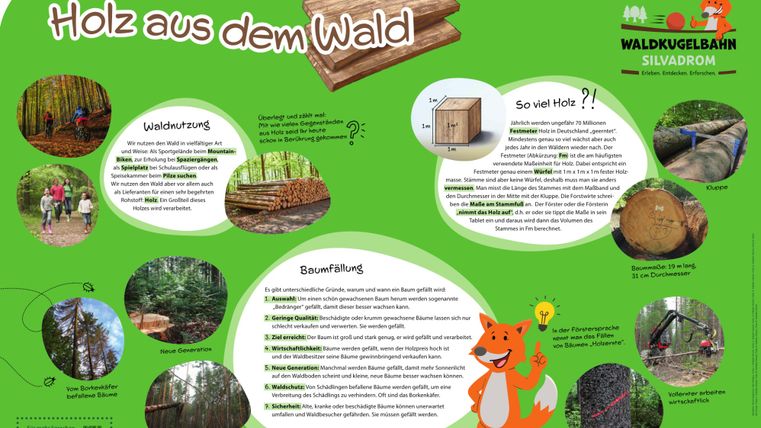
Wood from the forest
English
Forest use
We use the forest in many different ways: as a sports area for mountain biking, for recreation during walks, as a playground for school trips or as a pantry for mushroom hunting. Above all, however, we use the forest as a supplier of a highly sought-after raw material: wood. Much of this wood is processed.
Think about it and count: how many wooden objects have you come into contact with today?
That much wood?!
Approximately 70 million solid cubic metres of wood are ‘harvested’ in Germany every year. However, at least the same amount grows back in the forests every year. The cubic metre (abbreviation: Fm) is the most commonly used unit of measurement for wood. One cubic metre corresponds exactly to a cube with 1m x 1m x 1m of solid wood mass. However, logs are not cubes, so they have to be measured differently. The length of the trunk is measured with a tape measure and the diameter in the middle with a caliper. Foresters write the measurements on the base of the trunk. The forester ‘records the wood’, i.e. he or she types the measurements into a tablet, which then calculates the volume of the trunk in Fm.
Caliper
Tree dimensions: 19 m long, 31 cm diameter
Tree felling
There are various reasons why and when a tree is felled:
- Selection: Trees growing too close to a beautifully grown tree are felled to allow it to grow better.
- Poor quality: Damaged or crooked trees are difficult to sell and utilise. They are felled.
- Goal achieved: The tree is large and strong enough, so it is felled and processed.
- Economic efficiency: Trees are felled when the price of wood is high and the forest owner can sell his trees at a profit.
- New generation: Sometimes trees are felled so that more sunlight shines on the forest floor and small, new trees can grow better.
- Forest protection: Trees infested with pests are felled to prevent the spread of the pest. These are often bark beetles.
- Safety: Old, diseased or damaged trees can fall unexpectedly and endanger forest visitors. They must be felled.
In forestry jargon, felling trees is called ‘timber harvesting’.
Harvesters work economically
Goal achieved
New generation
Trees infested with bark beetles
Damaged trees
From tree to wood product
From tree to wood product
English
How does a tree actually become a cupboard?
Follow the tree's journey to becoming a wood product with your ball!